
How to Choose a Reliable Office Furniture Supplier in Melbourne
Here’s something most businesses learn the hard way. The price difference between the cheapest furniture quote and a mid-range one might be $8,000 on a 30-person fitout. The cost of choosing the wrong supplier — delayed delivery that holds up your entire fitout, furniture that arrives wrong and takes six weeks to replace, a warranty claim that goes nowhere because the supplier is impossible to reach — can easily exceed $30,000 when you count the full cost of disruption, project delays, and replacement.
We’ve been in the Melbourne commercial furniture market for over 27 years. We’ve seen businesses make every version of this mistake. And almost every time, the mistake wasn’t choosing the wrong furniture. It was choosing the wrong supplier.
The furniture is important. The supplier is more important. Because a great supplier will help you choose the right furniture. A poor supplier will let you choose the wrong furniture, deliver it late, and make it your problem when something goes wrong.
This guide walks you through exactly how to evaluate and choose a commercial furniture supplier in Melbourne. Not vague advice about doing your research — a specific, step-by-step framework that covers what to look for, what questions to ask, what red flags to watch out for, and how to compare suppliers on the things that actually matter.
By the end, you’ll be able to walk into any supplier conversation in Melbourne with confidence — knowing how to separate the businesses worth working with from the ones that will create problems you don’t need.

Why the Right Supplier Matters More Than Most Businesses Realise
The Hidden Costs of a Poor Supplier Relationship
The obvious cost of a bad supplier is obvious: you pay for furniture that doesn’t perform, and you have to pay again to replace it. But the hidden costs are usually much larger.
Delayed delivery is the most common and most expensive hidden cost. In a commercial office fitout, furniture delivery is almost always on the critical path. Construction finishes. IT gets installed. The building manager has cleared the loading dock window. And if the furniture doesn’t arrive on schedule, everyone waits. Every day of delay in a live fitout has a real cost — in contractor time, in project management, in staff who can’t start work in the new space.
Then there’s the problem resolution test. Any supplier looks fine when everything goes smoothly. The real measure of a supplier is what happens when something goes wrong — and in commercial furniture, something always goes wrong eventually. A damaged panel. A chair mechanism that fails in month three. A colour that arrives different to the sample. How a supplier handles these moments tells you everything about whether they’re worth working with long-term.
Poor communication is another hidden cost that businesses consistently underestimate. A supplier who doesn’t proactively communicate delivery schedules, delays, or issues forces you to spend time and energy chasing information that should come to you without asking. On a complex fitout project, that’s not a minor inconvenience — it’s a daily drain on your project management capacity.
And then there’s the long-term cost: buying furniture from a supplier you can’t return to. In two years, you hire 12 more people. You need 12 more chairs that match your existing ones. The supplier you bought from has discontinued the product, changed ownership, or simply doesn’t carry your spec anymore. You’re sourcing a replacement from scratch, spending money on something you shouldn’t have needed to spend money on.
What a Good Supplier Actually Delivers
A good commercial furniture supplier delivers more than furniture. They deliver certainty. You know the products will arrive when they’re supposed to, in the condition they’re supposed to, at the specification you agreed. You know that if something goes wrong, it will be resolved without you having to fight for it. You know that in three years, when your team grows, you can call the same person and get the same product.
They also deliver expertise. A supplier who genuinely knows commercial furniture — who understands Australian ergonomic standards, who knows which products perform in commercial use and which don’t, who can advise on specification rather than just process an order — helps you make better decisions. That expertise has real dollar value when it saves you from a specification mistake you didn’t know you were making.
The Melbourne Commercial Furniture Market — What You’re Navigating
The Melbourne commercial furniture market is more varied and harder to navigate than it’s ever been. You have established local specialists who’ve been supplying Melbourne businesses for decades. You have national chains with standardised product ranges and consistent service. You have direct importers and manufacturers selling without a dealer intermediary. You have online-only retailers offering competitive pricing but no physical presence. And you have new entrants who’ve set up relatively recently and whose track record is limited.
More choice is generally good for buyers. But more choice also means more variation in quality, reliability, and genuine commercial expertise. The low-barrier-to-entry nature of furniture importing means that businesses with no deep knowledge of commercial furniture standards, no established manufacturer relationships, and no long-term service infrastructure can present themselves in the market in ways that are difficult to distinguish from established suppliers until something goes wrong.
This guide gives you the tools to make that distinction before something goes wrong.
Step 1 — Define What You Actually Need Before You Approach Any Supplier
The businesses that get the best outcomes from commercial furniture suppliers are the ones that arrive with a clear brief. Not a fully engineered specification document — just a clear, honest picture of what they need, what they’re trying to achieve, and what constraints they’re working within.
Arriving at a supplier without this is like arriving at a car dealership and saying “I need something to drive.” You’ll get sold something. It might not be what you actually need.
Know Your Project Scope
A small furniture upgrade — replacing 10 task chairs and a couple of meeting room tables — needs a different supplier conversation than a full 60-person office fitout. Large, complex fitouts benefit most from suppliers with project management capability and broad range depth. Smaller, focused purchases can often be handled by a more specialist supplier.
Write down the categories of furniture you need, approximate quantities, and any specific requirements you already know about. Even a one-page brief — “we need 40 workstations with sit-stand desks, 40 task chairs, two meeting rooms with 8-person tables, a boardroom table for 14, and a breakout area for approximately 20 people” — gives a supplier enough to respond usefully rather than generically.
Be Realistic About Your Budget
Arriving at a supplier conversation with no budget framework is a common mistake. It either leads to overspending (because you’ve seen beautiful things and have no anchor for what’s reasonable) or to a frustrating back-and-forth where the supplier repeatedly quotes things you can’t afford.
You don’t need to reveal your exact budget ceiling. But having a range in mind — “we’re budgeting $X to $Y for the full furniture package” — allows a supplier to direct you to the right part of their range immediately. A good supplier won’t push you to the top of your budget. They’ll find the best specification for your budget and tell you honestly if it isn’t achievable.
If you don’t know what a realistic budget looks like for your project, ask. Any established Melbourne commercial furniture supplier can give you honest budget guidance based on scope. Our detailed pricing guides — available elsewhere on this site — also give you the framework to arrive at a supplier conversation better prepared.
Know Your Timeline
Timeline is one of the most important variables in supplier selection — and one of the most commonly overlooked until it’s too late. Custom and semi-custom furniture has manufacturing lead times of 8–14 weeks in most cases. Stock items can typically be delivered in 2–4 weeks. If your fitout is scheduled to complete in six weeks and you need custom boardroom furniture, you need to be having supplier conversations now, not in four weeks.
Be honest about your timeline with potential suppliers. A supplier who tells you that your timeline is achievable when it isn’t is more dangerous than one who tells you the truth and helps you find solutions. The truth might mean adjusting your timeline, choosing stock items over custom, or phasing delivery. All of these are manageable. Discovering the problem two weeks before your move-in date is not.
Know Your Quality and Compliance Requirements
Before you approach any supplier, know whether you have specific compliance requirements that need to be met. Do you have WHS obligations that require chairs meeting AS/NZS 4438? Are you pursuing Green Star or NABERS certification that affects your material and furniture specification? Do you have a sustainability procurement policy that requires GECA certification, GREENGUARD Gold, or Environmental Product Declarations?
Knowing your compliance requirements going in means you can assess immediately whether a supplier can meet them — rather than discovering mid-project that the products you’ve committed to don’t have the certification your project requires.
Step 2 — Understand the Types of Suppliers and Which Suits Your Project
Not all commercial furniture suppliers are the same type of business. Understanding the different models operating in the Melbourne market helps you approach the right type of supplier for your specific project.
Commercial Furniture Dealers and Specialists
Commercial furniture dealers source, specify, and supply furniture from multiple manufacturers. They carry broad product ranges across categories — workstations, chairs, meeting room furniture, storage, breakout — and have the specification expertise to advise across a full fitout brief.
The strengths of this model are range depth, genuine specification expertise, project management capability, and ongoing warranty support. A good commercial furniture dealer has relationships with reputable manufacturers, knows which products perform in commercial use, and can manage a complex, multi-category furniture project from brief to installation.
This model suits medium to large fitouts, businesses that need guidance on specification rather than just order fulfilment, and projects with mixed furniture categories where a single supplier managing everything is more efficient than managing multiple category specialists.
Fitout Companies With In-House Furniture Supply
Some commercial fitout companies — Progressive Corporate is one of them — manage the full office fitout including design, construction, and furniture supply under one roof. The significant advantage of this model is integration: furniture selection happens in the context of the space planning and construction, so everything is coordinated from the start rather than being figured out separately.
The furniture arrives when the space is ready. The power and data runs are positioned where the furniture needs them. The boardroom table specification is designed alongside the AV installation. Problems are resolved by one business rather than being referred between a furniture supplier and a fitout contractor who each point at the other.
When evaluating this model, verify that the company genuinely supplies furniture — not that they subcontract furniture supply to a third party while presenting themselves as a one-stop shop. Ask to see their furniture range, their product certifications, and past projects where they’ve supplied furniture as part of a full fitout.
Direct Importers and Manufacturers
Direct importers and manufacturers sell without a dealer intermediary. Their pricing on specific product lines can be competitive, and their knowledge of their own products is deep.
The limitation is range. A direct importer of task chairs knows task chairs — but probably can’t supply your boardroom table, your workstation system, and your breakout seating at the same standard. If you know exactly what you want and you want a lot of it, a direct importer can be good value. If you need specification guidance across multiple categories, this model is limiting.
The key questions for direct importers: who handles warranty claims in Australia if the manufacturer is overseas? Are spare parts held locally? What happens to warranty support if the business changes model or closes? These aren’t hypothetical concerns — they’re real risks in a market where small importing businesses come and go.
Online-Only Commercial Furniture Suppliers
Online furniture retail has grown significantly. For supplementary purchases, accessories, and products you already know well, online suppliers can be efficient and cost-effective.
For primary commercial furniture purchases — particularly task chairs, boardroom tables, and modular workstation systems — buying online without seeing, sitting in, or physically assessing the product is a significant risk. Product photography is optimistic. Description language is marketing. The stability of a sit-stand desk at maximum height, the lumbar support quality of a task chair, the surface finish of a boardroom table — none of these can be properly evaluated on a screen.
If you’re considering an online supplier for a significant purchase: ask whether they can provide samples. Check their return and exchange policy in detail. Read independent reviews from commercial buyers rather than residential ones. And treat any supplier who can’t provide AFRDI certification documentation promptly as a risk.
Warning Signs in the Melbourne Market
Some patterns consistently predict supplier problems. Watch for them:
- Suppliers who can’t name the relevant AS/NZS standard when you ask about it. Standards knowledge is basic for any serious commercial furniture business.
- Pricing that seems too good for the specification claimed. Commercial-grade, AFRDI Level 6 certified task chairs don’t cost $150. If they’re priced like they do, they aren’t what they claim to be.
- Businesses with very limited online presence, no reviews, and no verifiable track record. A business that’s been in the Melbourne market for ten years has a traceable history. One that set up recently has a much thinner one.
- High-pressure sales tactics or urgency manufactured around limited stock. A supplier who needs to close you today is a supplier who doesn’t expect you to spend more time evaluating them.

Step 3 — Evaluate Supplier Credentials and Track Record
Once you’ve identified suppliers who fit your project type, the next step is evaluating their actual credentials and track record. This is where most businesses do too little due diligence — and where the consequences of skipping it are most significant.
Years in Business and Melbourne Market Experience
Longevity in the Melbourne commercial furniture market is a meaningful quality indicator. It’s not infallible — long-established businesses can have complacent service — but a supplier who’s been operating in Melbourne for 10, 15, or 20+ years has a track record you can verify, client relationships you can check, and an institutional knowledge of the Melbourne market that a new entrant simply doesn’t have.
They know how Melbourne CBD buildings handle furniture deliveries — loading dock booking systems, lift restrictions, after-hours access requirements. They know which products hold up in Melbourne’s climate and commercial environment. They’ve navigated supply chain disruptions, dealt with manufacturer quality issues, and built the processes for handling problems that new businesses are still figuring out.
Verify actual years in business — not just when the current website was launched. Business registration records, review histories, and the tenure of key staff are all useful data points.
Client Portfolio and Project References
This is the single most important indicator of a supplier’s real-world performance. Not their brochure. Not their website. Not their showroom. The clients they’ve actually served, the projects they’ve actually completed, and what those clients say about working with them.
Ask every potential supplier for three references from projects completed in the last two years, at a similar scale and scope to yours. A supplier who can’t or won’t provide this is a supplier with something to hide — either a thin track record, unhappy clients, or both.
When you speak to references, ask specific questions: Was delivery on time and as specified? How did the supplier handle problems when they arose? Was communication proactive or did you have to chase information? Would you use them again? The last question is the most telling. A client who’d use a supplier again is a genuine endorsement. A client who answers hesitantly is a signal worth noting.
Client logos on a website are marketing. References who answer your calls and give genuine answers are evidence.
Showroom Presence and Physical Location
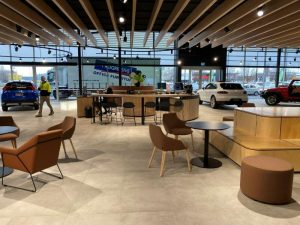
A Melbourne showroom is a meaningful quality indicator for a commercial furniture supplier. Maintaining a quality showroom requires investment — in space, in product, in staff. Suppliers who make that investment are making a statement about their commitment to the Melbourne market and their confidence in the quality of what they sell.
A showroom visit also gives you far more useful information than any catalogue or website. You can sit in the chairs. You can check sit-stand desk stability at maximum height. You can assess surface finish quality, compare materials, and see how products actually look at full scale rather than in optimised product photography.
When you visit a showroom, pay attention to: whether the products you’re considering are actually on display (a showroom that only has product renders on screens isn’t a functional assessment environment), the condition and presentation of the space (a well-maintained showroom suggests a well-run business), and whether the staff can answer technical specification questions confidently (not just process your enquiry).
Manufacturer Relationships and Brand Portfolio
Ask potential suppliers which manufacturers they represent or have formal relationships with. The answer tells you several things: the quality tier of the products they supply, the stability of their supply chain, and whether their warranty support is backed by the manufacturer or dependent on the supplier’s own capacity to resolve issues.
An established dealer relationship with a reputable commercial manufacturer — one with a genuine Australian presence, a warranty fulfilment process, and a product range backed by independent testing — is very different from opportunistic importing of unbranded product from a changing roster of overseas suppliers.
Ask specifically: if I have a warranty claim on this product in two years, what is the process and who handles it? A clear, specific answer to this question — with a named manufacturer contact or process — is reassuring. A vague answer about “talking to the team” is not.
Step 4 — Assess Product Quality and Standards Compliance
We covered Australian ergonomic standards in detail in our companion article on this site. Here, the focus is on how to use standards compliance as a supplier evaluation tool — not just a product specification requirement.
The Compliance Question Test
Ask every potential supplier the same question early in the conversation: “Does your task chair range comply with AS/NZS 4438, and can you provide AFRDI certification documentation?”
A supplier who answers clearly — who names the standard correctly, explains what compliance means for the product, and can produce documentation without hesitation — is a supplier who knows their product category properly. This isn’t a trick question. It’s a basic competency test for any serious commercial furniture business.
A supplier who deflects, gives a vague answer about “meeting international standards”, confuses AS/NZS 4438 with something else, or needs to “check with the warehouse” to answer a compliance question is telling you something important about how deeply they actually know their products.
Run the same test for AFRDI Level 6 certification and, if relevant to your project, GREENGUARD Gold. These three questions, asked early, reveal more about a supplier’s genuine commercial furniture expertise than any sales pitch.
Certification Documentation vs. Claims
There is a meaningful difference between a supplier who says their product “complies with” a standard and one who can produce the certification documentation proving it. Self-declared compliance — where the supplier has reviewed the standard and decided their product is probably compliant — is not the same as independent testing and certification.
For chairs, ask for the AFRDI certificate number and verify it at afrdi.com.au. For desks and workstation systems, ask for the specific testing data or certification that supports compliance claims. For acoustic products, ask for NRC ratings backed by independent test data.
A supplier who can provide this documentation promptly and specifically is a supplier whose compliance claims are genuine. One who provides documents that are vague, undated, or reference different product models than what you’re buying is a supplier whose claims deserve closer scrutiny.
Range Depth and Specification Flexibility
Can the supplier meet your full furniture brief, or will you need to manage multiple suppliers to cover all your categories? Managing multiple furniture suppliers on a fitout project multiplies your coordination effort — different lead times, different delivery schedules, different installation teams, different invoice processes.
Also ask about specification flexibility: can they supply the chair you’ve selected in the specific fabric colour you need for your fitout? Can they provide a non-standard desk dimension for an awkward corner space? Can they source a product from their range that isn’t on the showroom floor? A supplier with deep range relationships can often fulfil these requirements. One whose range is limited to what’s on display cannot.
Sample and Trial Policy
For task chairs specifically, the ability to trial a chair before committing to a bulk order is non-negotiable. Any reputable commercial furniture supplier understands this and accommodates it. A supplier who won’t provide a chair sample for a week-long trial before you order 50 of them is a supplier who’s either not confident in the product or not interested in earning your long-term business.
Ask about their process for handling products that arrive not as specified — wrong colour, wrong configuration, damaged in transit. Clear, documented processes for resolving these issues are a sign of a supplier who’s dealt with real projects at scale. No process, or a vague “we’ll sort it out” response, is a sign they haven’t.

Step 5 — Evaluate Delivery, Installation, and After-Sales Support
The sale is the beginning of the relationship, not the end. How a supplier manages delivery, installation, and the post-purchase experience is at least as important as the quality of what they sell.
Delivery Capability
Melbourne is a geographically spread city with significant variation in delivery complexity. Delivering to a CBD high-rise — with loading dock booking systems, lift access restrictions, and building management oversight — is a very different logistical exercise than delivering to a suburban office park in Knoxfield or Dandenong. Confirm that your supplier has genuine experience with deliveries to your specific type of location.
For large fitouts, ask specifically about their process for phased delivery — furniture arriving in stages as different parts of the fitout complete, rather than all at once when the space may not be ready to receive it. Ask about their process for delivering into live office environments where the business is still operating during a partial refurbishment.
Ask about oversized items. A 4-metre boardroom table doesn’t fit in a standard lift. Suppliers with genuine experience in commercial fitouts have solutions for this. Suppliers who haven’t thought about it will discover the problem on delivery day — which is the worst time to discover it.
Installation Services
For standard items like individual chairs and simple desks, delivery and basic assembly is typically sufficient. For complex items — modular bench workstation systems, height-adjustable bench runs, large boardroom tables with technology integration — professional installation matters significantly. Poor installation of a modular workstation system creates alignment problems, cable management issues, and stability problems that persist for the life of the product.
Ask whether the installation team is employed by the supplier or subcontracted. Subcontracted installation isn’t automatically bad — but undisclosed subcontracting (where you think you’re getting the supplier’s team and you’re actually getting whoever was available that week) is a transparency problem. Who installs your furniture affects the quality of the installation. Know who it is.
Ask whether ergonomic setup guidance is included as part of the installation service. A supplier who delivers 40 sit-stand desks and 40 task chairs and leaves without any orientation for the people who’ll be using them has completed the delivery but missed the point. The furniture won’t deliver its ergonomic benefit if nobody knows how to set it up correctly.
Warranty Terms — Read Them Properly
Commercial furniture warranty terms vary significantly — not just in length, but in what they actually cover, what voids them, and who manages the claim process.
A supplier who tells you their chairs come with a “5-year warranty” has given you one number that tells you almost nothing useful. Does that warranty cover the mechanism only, or the upholstery too? Does it cover normal wear or only manufacturing defects? Is it a repair warranty or a replacement warranty? Does it apply to commercial use at the intensity you’re planning, or only to light use? Is it managed by the supplier directly or are you referred to the manufacturer?
Get warranty terms in writing. Read them. Ask specifically: if the chair mechanism fails in month 18, what is the process and who pays for what? A supplier who can answer this question clearly and specifically is a supplier whose warranty means something.
Also ask about spare parts. Mechanisms, castors, gas lifts, replacement surfaces — these components have finite lifespans in commercial use. A supplier who doesn’t carry spare parts for the products they sell creates a situation where a relatively minor component failure requires a full product replacement. Ask explicitly whether parts are stocked in Melbourne and for how long the supplier commits to maintaining parts availability.
Ongoing Supply and Account Management
Your furniture requirements don’t end when the fitout completes. Businesses grow. Staff turn over. Products get damaged and need replacing. In two years, you might need 15 more chairs that exactly match what you already have.
Ask the supplier specifically: if I need 15 more of this chair in two years, can you supply it at consistent specification? How long do you expect this product to be available? Do you hold stock in Melbourne or is it imported to order?
A supplier who offers genuine account management — a dedicated contact, priority service, stock access for existing clients — is building a long-term relationship rather than just closing a sale. This is worth more than it might seem when you need something quickly and without the full procurement process.

Step 6 — Getting and Comparing Quotes
How to Structure a Quote Request
A well-structured quote request produces quotes you can actually compare. Ask all suppliers to quote against the same specification — same quantities, same categories, same delivery and installation requirements, same timeline. If a supplier recommends an alternative product, ask them to quote both their recommendation and your original specification so you can assess the substitution on a level basis.
Include in your quote request: itemised quantities by product category, specific specification requirements (standards compliance, AFRDI level, finish options), delivery address and any known building access requirements, whether installation is required, timeline for delivery, and your required warranty terms.
What a Good Quote Looks Like
A good commercial furniture quote is itemised — you can see exactly what you’re paying for each product, what the delivery and installation costs are, and what’s included vs. excluded. A lump sum quote is a red flag: it makes it impossible to compare suppliers meaningfully and gives you no visibility into where the money is going.
Each line item should include: product name and model number (not just a generic description), dimensions and finish/colour specification, unit price and total price, warranty terms, and lead time. Delivery, installation, and any project management costs should be explicitly stated as inclusions or exclusions — not buried in assumptions.
Payment terms and deposit requirements should be clearly stated. Commercial furniture suppliers typically require a deposit on order — 30–50% is standard — with the balance on delivery. Suppliers requiring full payment upfront before manufacture is complete are asking you to carry all the financial risk. This is worth negotiating on large orders.
The Lowest Price Is Not the Best Value
We’ve said this before and it’s worth saying clearly: in commercial furniture, the cheapest quote almost never represents the best value over the life of the product and the supplier relationship.
Calculate total cost of ownership, not just purchase price. A task chair that costs $350 and lasts three years before mechanism failure costs more over a seven-year lease than a chair that costs $600 and performs reliably for the duration. A supplier who charges $500 more for a delivery but arrives on time and installs correctly saves money compared to a supplier who charges $500 less but creates a week of fitout delay.
When you receive quotes that are significantly lower than others for comparable specification, ask why. Sometimes it’s genuine efficiency. More often it’s a difference in product quality, warranty coverage, or service inclusions that isn’t visible in the headline price. Ask the supplier to explain the difference specifically. Their answer will be informative.
What Is and Isn’t Negotiable
Volume discounts on large orders are negotiable. Delivery costs can sometimes be negotiated, particularly on large projects. Installation inclusions can often be negotiated — a supplier who wants a large project will sometimes include installation at reduced or no cost to secure the business. Payment terms on large orders can be negotiated.
Quality standards are not negotiable — a supplier who offers to reduce their AFRDI specification to hit a lower price point is offering you a worse product, not a better deal. Lead times driven by manufacturer production schedules are not negotiable — a supplier who promises faster delivery than the manufacturer lead time allows is making a promise they can’t keep. Warranty terms on structural components shouldn’t be negotiated downward.

Step 7 — Red Flags to Watch For
Even after following the steps above, some supplier problems only become apparent through specific signals. Here’s a consolidated list of the red flags worth watching for across the whole evaluation process.
Operational Red Flags
- No physical Melbourne showroom for a supplier pitching large commercial projects — they’re asking you to commit significant money to products you’ve never physically assessed
- Unable or unwilling to provide references from comparable projects when asked
- Warranty commitments that are verbal only — nothing confirmed in writing in the quote
- Unusually fast lead time promises on custom or semi-custom furniture — often a sign of quality shortcuts or a supplier who hasn’t actually checked manufacturer availability
- No clear single point of contact for the project — multiple people involved with no designated accountability
Product Red Flags
- Products marketed as “commercial grade” or “ergonomic” without AFRDI certification to support the claim
- Supplier can’t name AS/NZS 4438 when asked specifically about chair ergonomic standards compliance
- Structural warranty shorter than five years on products described as commercial grade
- Products that look identical to known cheap imports with a premium brand or label applied over the original manufacturer markings
Relationship Red Flags
- Slow, inconsistent communication during the evaluation phase — this is what the relationship looks like when the supplier is trying to win your business. It gets worse after the sale.
- Reluctance to provide itemised quotes — often a sign the supplier doesn’t want component pricing scrutinised
- Pushback on providing references from comparable projects — a supplier who’s genuinely proud of their work is happy for you to check
- Undisclosed subcontracting of installation — you think you’re getting the supplier’s team, you’re getting an unknown third party
Questions to Ask Every Potential Supplier
Here’s a consolidated list of questions to bring to every supplier conversation. You don’t need to run through all of them in every meeting — use them as a framework and let the conversation guide which ones become most relevant.
About Their Business
- How long have you been supplying commercial furniture in Melbourne?
- Can you provide references from three projects at a similar scale to mine, completed in the last two years?
- Do you have a Melbourne showroom where I can see and test the products I’m considering?
- Which commercial furniture manufacturers do you represent or have formal relationships with?
About the Products
- Does this chair comply with AS/NZS 4438? Can you provide the AFRDI certification documentation?
- What is the warranty on this product and what specifically does it cover? Is the upholstery included?
- Do you carry spare parts for this product line in Melbourne? How long will you maintain parts availability?
- Can I order additional pieces from this range in two to three years at consistent specification?
About the Project
- Who will be my single point of contact through this project?
- What is your delivery and installation process for a project of this size and location?
- How do you handle products that arrive damaged or incorrect?
- What is your process if there are delays on your end that affect our fitout schedule?
About After-Sales Support
- Who handles warranty claims — you directly, or are we referred to the manufacturer?
- What is your typical response time for warranty issues in a live office environment?
- Do you provide ergonomic setup guidance as part of the installation service?
- What does an ongoing account relationship look like with your business after the initial purchase?
Your Supplier Evaluation Checklist
Use this checklist to evaluate and compare potential suppliers before making a final decision.
Business Credentials
- 5+ years in the Melbourne commercial furniture market (10+ preferred for large projects)
- Physical Melbourne showroom with the products you’re considering available to view and test
- Client portfolio with recognisable Melbourne businesses at relevant project scale
- References available, willing to talk, and saying the things you’d want to hear
- Public liability and professional indemnity insurance confirmed
Product Quality
- AFRDI Level 6 certification for task chairs and commercial desks — documented with certificate number
- AS/NZS 4438 compliance for task chairs — independently tested, not self-declared
- Commercial warranty of at least 5 years on structural components — confirmed in writing
- Spare parts availability confirmed for key product lines
- Chair sample or trial policy available before bulk order commitment
Service Capability
- Professional installation team confirmed — employed or disclosed subcontracting
- Melbourne delivery capability for your specific location and building type confirmed
- Dedicated project management for medium to large projects
- Single point of contact confirmed with name and direct contact details
- Clear escalation process for delivery or product problems explained
After-Sales Support
- Warranty claim process clearly explained and confirmed in writing
- Product range continuity for future matching purchases confirmed
- Ongoing account management available after initial purchase
- Ergonomic setup guidance offered as part of installation service
Why Melbourne Businesses Choose Local and Established Suppliers
There’s a reason why Melbourne’s most sophisticated businesses — the ones with professional procurement processes and experienced facilities managers — consistently gravitate towards established local commercial furniture suppliers rather than chasing the cheapest quote in the market.
A local Melbourne supplier who’s been in the market for 20 years knows things that newer or interstate suppliers genuinely don’t. They know Melbourne CBD building access and loading dock procedures intimately. They know which manufacturers have reliable Australian stock and which have chronic supply chain issues. They know which products perform in Melbourne’s commercial environment over time and which look good in the showroom but fail in use.
They also have a track record you can verify. You can speak to clients from five years ago — not just last month. You can see the furniture they’ve supplied still performing in real Melbourne offices. You can assess their warranty support based on how they’ve actually handled claims rather than based on what they promise they’ll do.
And they have skin in the game that a national chain or online-only supplier doesn’t. An established local supplier’s reputation in the Melbourne market is their business. A poor outcome for your project is a problem for them that goes beyond just your account. That accountability creates a different kind of service relationship.
None of this means you should pay any price an established supplier asks, or that newer suppliers can’t do good work. It means that when you’re weighting the factors in your supplier decision — price, quality, credentials, track record, service — the value of genuine Melbourne market experience and a verifiable long-term track record is real and worth pricing into your evaluation.
Looking for a Reliable Melbourne Office Furniture Supplier? Here’s Ours.
We started this guide by saying that the supplier matters as much as the furniture. So let us be direct about who we are and what we offer — and let you apply the framework in this article to evaluate us the same way you’d evaluate anyone else.
Progressive Corporate has been supplying commercial office furniture and delivering full office fitouts across Melbourne for over 27 years. We have a working showroom in Knoxfield where you can see, sit in, and properly assess the products we supply before committing to anything. We have a client portfolio that includes Telstra, Kia, Commonwealth Bank, RMIT, Monash University, Victoria Police, and hundreds of Melbourne businesses of every size — and we’re happy for you to call any of them.
Every task chair we supply for commercial use meets AS/NZS 4438 and carries AFRDI Level 6 certification. Every desk meets AS/NZS 4442. We carry the documentation and will provide it at any point in the conversation — not after you’ve committed to an order.
We offer a full project service: single point of contact, professional installation by our own team, ergonomic setup guidance for your staff, and ongoing account management so that when you need 12 more chairs in two years, the person who knows your specification answers the phone.
And because we also manage full office fitouts — design, construction, and furniture — we can coordinate everything under one roof for businesses planning a complete new office or major refurbishment.
If you’re planning a new fitout, upgrading existing furniture, or just doing your supplier due diligence — come and talk to us. Bring your brief, your floor plan, your compliance requirements, and your questions. We’ll give you honest answers, transparent pricing, and genuine recommendations based on what your project actually needs.
📞 (03) 7018 0761
📧 sales@progressiveoffice.com.au
📍 1 Forbes Close, Knoxfield VIC 3180
The right supplier makes every furniture decision easier. Let’s see if we’re the right one for you.