

The Melbourne office of 2026 looks nothing like the Melbourne office of 2019.
And we’re not just talking about the layout. The furniture itself has changed — what it’s made of, how it works, what it’s designed to do to the people who use it. The forces reshaping office furniture right now are more varied and more interesting than any single trend cycle we’ve seen in the past two decades.
Hybrid working has matured from a pandemic experiment into a permanent feature of how Melbourne businesses operate. The war for talent hasn’t gone away — if anything, it’s pushed businesses to invest more seriously in workspace quality as a recruitment and retention tool. Sustainability has moved from a marketing checkbox to a procurement obligation. And the office, after years of identity crisis, has found a new and more confident purpose: not a place where people come because they have to, but a place worth coming to because it offers something home working can’t.
All of this is showing up in the furniture decisions Melbourne businesses are making right now. The trends in this guide aren’t speculative. They’re what we’re seeing in actual fitout projects across the city — in the CBD, in South Melbourne and Richmond, in Cremorne and Collingwood and the suburban business parks of the eastern suburbs.
Whether you’re planning a new office fitout, refreshing an existing space, or just trying to get a read on where commercial furniture is heading — this guide gives you the clearest picture available of what 2026 looks like on a real Melbourne office floor.
The State of the Melbourne Office in 2026
Before the trends, some context. Because the furniture decisions businesses are making right now make a lot more sense when you understand the environment they’re responding to.
Hybrid working has stabilised. The frantic experimentation of 2021 and 2022 — two days in, three days in, fully flexible, no assigned desks, everyone in on Tuesdays — has settled into more predictable patterns for most Melbourne businesses. Most professional organisations have landed on a hybrid model that actually works for their team, and they’re now designing and furnishing their offices around that model rather than trying to accommodate every possible permutation.
The conversation has shifted. It’s no longer “how do we get people back to the office.” It’s “how do we make the office genuinely better than working from home for the things that matter.” That’s a fundamentally different design brief — and it’s producing fundamentally different furniture choices.
Melbourne workers in 2026 are clear about what they need from the office. Spaces for collaboration that work better than a video call. Social connection with colleagues. Access to equipment and resources that aren’t practical at home. And an environment that’s genuinely comfortable, well-designed, and worth the commute.
The businesses responding to that brief well are investing in furniture quality, variety, and thoughtfulness in a way that wasn’t common five years ago. The businesses that haven’t updated their thinking — or their furniture — are feeling the difference in employee satisfaction scores and attendance patterns.
Trend 1 — Human-Centred Design Takes Centre Stage
This is the trend underpinning almost every other trend in this guide. Human-centred design — the principle that office furniture should be designed around how real people actually work, move, and feel — has gone from a niche philosophy to the primary commercial furniture brief in 2026.
For most of office furniture history, workstations were designed around efficiency and standardisation. One height fits most. One configuration for everyone. Ergonomic adjustment was a specialist concern for people with injuries, not a design baseline for every workstation.
That’s changing fast. The research connecting workspace design to health outcomes, productivity, and employee satisfaction has become impossible to ignore for businesses that take their people seriously. And the furniture market has responded — human-centred design principles are now embedded in mainstream commercial products, not just specialist ergonomic lines.
What Human-Centred Furniture Looks Like in 2026
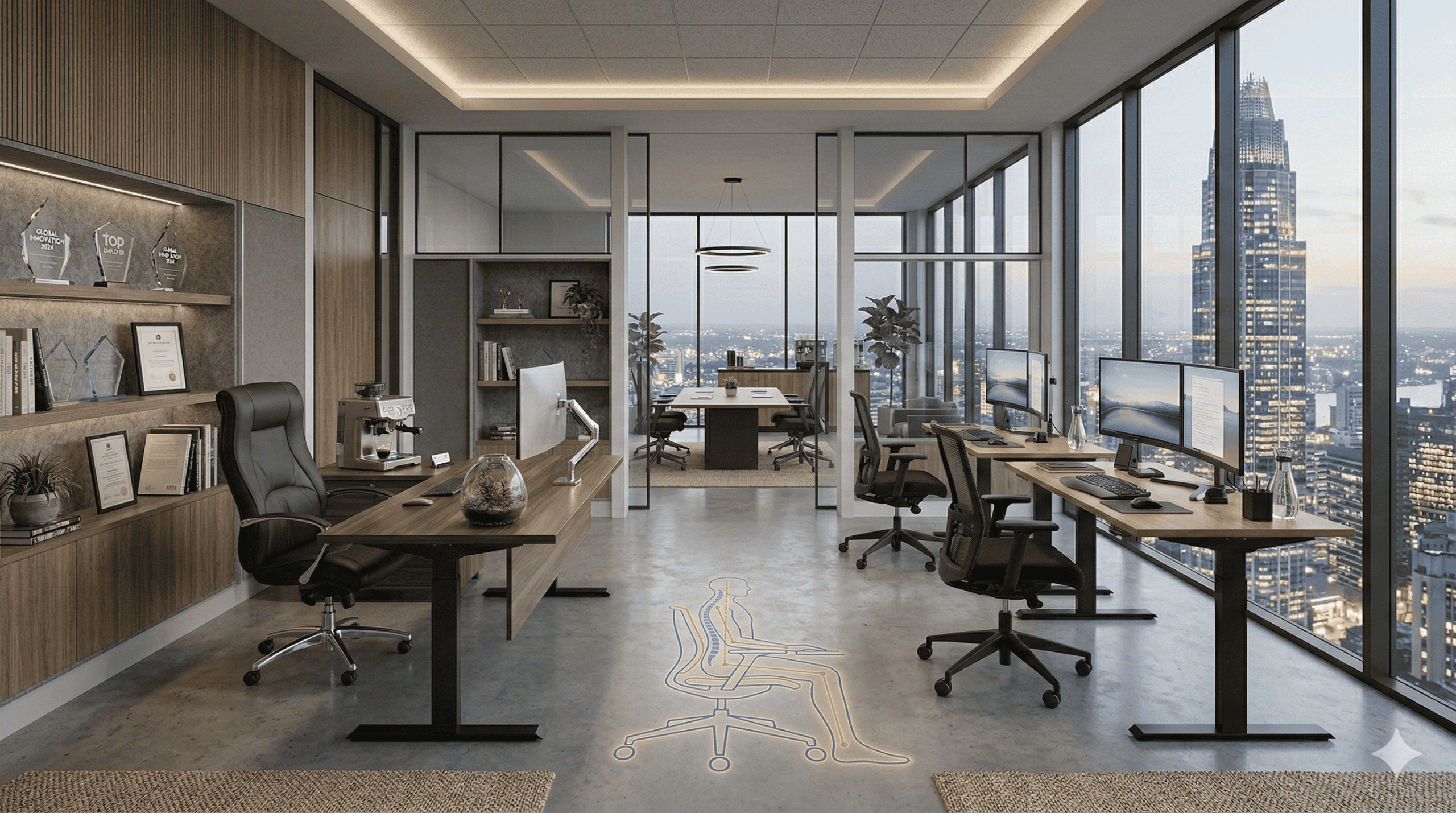
Sit-stand desks are no longer a premium option in Melbourne office fitouts. They are the baseline specification. Businesses fitting out new offices in 2026 that are still speccing fixed-height desks as the standard are behind the curve — and their employees know it.
Beyond sit-stand, human-centred furniture in 2026 includes chairs that genuinely accommodate a wider range of body types — not just average-height adults of average build, but the full range of heights, weights, and physical characteristics represented in a real Melbourne workforce. Seat depth adjustment, lumbar adjustability, and armrest range are being specified more carefully than ever.
There’s also growing attention to neurodiversity in workplace design. Furniture that accommodates different sensory preferences — quieter zones with acoustic furniture, areas with lower stimulation, flexible seating options that allow people who can’t sit still to work productively in ways that suit them. This isn’t niche anymore. Melbourne businesses with thoughtful HR and people teams are incorporating neurodiversity considerations into their fitout briefs as standard.
Active seating is gaining real traction — saddle chairs, balance chairs, perch stools, and rocker bases that encourage micro-movement during seated work. The research supporting these products has matured and the products themselves have improved significantly in both quality and aesthetics. These aren’t gimmicks. For the right person and the right role, they provide genuine benefit.
The practical application for Melbourne businesses: when you’re writing your furniture brief for 2026, start with the people using the furniture, not with the floor plan. What types of work do they do? How long do they sit? What physical requirements do they have? What would make their workday physically better? Those answers should drive your specification.
Trend 2 — Biophilic Design Moves From Accent to Architecture
A few years ago, biophilic design in a Melbourne office meant a living wall behind reception and some timber veneer on the boardroom table. It was decorative. It was optional. And it was almost always one of the first things cut when the budget got tight.
In 2026, biophilic design is embedded in the furniture specification itself — not applied as a finishing layer on top of a conventional fitout.
The research driving this shift is solid and consistent. People in workspaces with natural materials, natural light, organic forms, and connections to living things report lower stress levels, higher concentration, and greater satisfaction with their work environment. These outcomes are measurable and repeatable across studies. Melbourne businesses that are serious about workplace wellbeing are taking them seriously.
How Biophilic Design Is Showing Up in Furniture in 2026
Timber finishes have evolved. In 2026, it’s not just about timber veneer — it’s about character-grade timber, reclaimed timber, and visible grain and knot structures that celebrate natural variation rather than hiding it. The perfect, uniform timber look of the 2010s corporate fitout is being replaced by surfaces with genuine natural character.
Natural textiles are replacing synthetic upholstery in premium specifications. Wool, linen, cotton-blend weaves, and natural leather are showing up in workstation chairs, meeting room seating, and breakout furniture where commercial-grade synthetic fabrics dominated before. The challenge is durability — natural textiles require more careful specification and maintenance — but the sensory and aesthetic difference is significant.
Curved and organic furniture forms are replacing the sharp-cornered, rectilinear designs that dominated commercial furniture for decades. Desks with softened corners. Tables with gently curved edges. Chairs and sofas with organic silhouettes. The angular corporate aesthetic is softening — and Melbourne offices are better for it.
Warm, earthy colour palettes in upholstery and surface finishes are pushing out the corporate grey and black that defined commercial furniture for so long. Terracotta, warm sand, sage green, ochre, and rust are appearing in serious commercial fitouts across Melbourne. These aren’t residential whims — they’re evidence-backed choices that create warmer, more human environments.
Furniture with integrated planting — desks with built-in planter boxes, shelving units that incorporate moss or succulent arrangements, partition systems with living plant integration — is moving from hospitality and retail into mainstream commercial office specification.
The design challenge with biophilic furniture is avoiding the look of a garden centre that’s been mistaken for an office. Natural materials and organic forms need to be deployed with discipline and quality — the goal is a professional, polished environment that happens to feel genuinely alive and connected to the natural world. When it’s done well, it’s among the most compelling office design work being produced in Melbourne right now.
Trend 3 — Flexible and Reconfigurable Everything
If there’s a single word that defines the commercial furniture brief in 2026, it’s flexibility.
Hybrid working means office occupancy fluctuates. Monday might be 40% capacity. Wednesday is 90%. Friday is 30%. The same floor needs to feel right — not awkwardly empty, not uncomfortably crowded — across that whole range. Fixed furniture that’s designed for one density level is a daily compromise for every other density level.
Add to this the reality that most Melbourne businesses genuinely don’t know what their office will need to accommodate in three years. Growth, contraction, changes in working model, team restructuring — the businesses that have bought inflexible furniture and had to make expensive changes halfway through a lease know this feeling well.
The 2026 response is furniture that’s designed to change. Not just physically moveable, but genuinely reconfigurable — products that serve different purposes in different arrangements, that can be added to as the team grows, and that can be reconfigured by the people who use the space without needing a contractor.
The Furniture Categories Being Transformed by Flexibility
Modular seating systems are one of the most significant product category developments in commercial furniture right now. Systems where individual components — corner sections, straight sections, ottoman pieces, privacy wings, and back panels — can be combined and recombined into configurations that range from a two-person conversation setting to a large collaborative lounge to a semi-private meeting alcove. One product investment serves a dozen different needs.
Folding and nesting tables have improved dramatically in quality and aesthetics. The cheap folding table of the training room is being replaced by genuinely design-led products that fold and stack without looking like they’re apologising for it. Flip-top tables that nest together for compact storage and deploy quickly into classroom, boardroom, or workshop configurations are standard in any 2026 fitout with a multipurpose space.
Mobile furniture — desks, storage units, whiteboards, and display screens on quality castors — is being used more thoughtfully and more ambitiously than before. Not just as a convenience, but as a genuine design strategy. An office where the furniture moves is an office that can be a different office tomorrow. Melbourne businesses with large open floors are using mobile furniture to create event spaces, town hall configurations, and collaborative workshops without any construction.
Freestanding acoustic pods and booths are one of the fastest-growing furniture categories in Melbourne commercial fitouts. The ability to create a private meeting space or focus enclosure without building a room — a furniture decision rather than a construction one — has obvious appeal for businesses operating in leased spaces where construction works require landlord approval and significant cost.
The caution with flexible furniture: flexibility has a cost. Folding tables are never as substantial as fixed ones. Mobile furniture requires quality castors and locking mechanisms to perform reliably. Modular seating systems require proper specification to avoid looking like they’ve been assembled randomly. The investment in genuinely good flexible furniture is higher than the equivalent in fixed furniture — and it’s worth it. Cheap flexible furniture is worse than good fixed furniture in almost every way.
Trend 4 — The Wellness Office: Furniture as Health Infrastructure
Workplace wellness in 2026 has grown up. It’s no longer ping pong tables and a bowl of fruit on the kitchen counter. It’s embedded in the physical design of the workspace — in the furniture specification, the acoustic environment, the lighting design, and the variety of spaces available to people throughout the workday.
Melbourne businesses with formal workplace wellness strategies — and there are more of these every year — are now specifying furniture as health infrastructure. Not as a metaphor. As a literal description of what the furniture is for.
Active and Movement-Encouraging Furniture
Sit-stand desks are the foundation. But in 2026, the movement conversation has moved past sit-stand to the broader question of how the physical office environment encourages people to move throughout the day — not just to stand at their desk, but to walk, shift position, stretch, and engage their bodies in ways that break the cycle of prolonged sedentary posture.
Active seating has gained real mainstream traction. Saddle chairs — which tilt the pelvis forward into a more neutral spinal position and engage core muscles during seated work — are appearing in commercial fitouts well beyond the ergonomic specialist category. Balance chairs, wobble stools, and rocker bases that provide continuous low-level movement during seated work are being specified by businesses who’ve done their homework on the research and found it compelling.
Standing collaboration tables near kitchens and walkways are being specified specifically to encourage brief standing interactions — the kind of conversations that in a traditional office would have happened at a fixed meeting table but that genuinely work better standing. These aren’t just a design choice. They’re a behavioural architecture choice.
Treadmill desk integration is entering the mainstream premium fitout in Melbourne. A few years ago it was a curiosity. In 2026, it’s a feature that forward-thinking organisations are including in their wellness zones — not for everyone, not all the time, but available as an option for people who want to walk slowly while doing email or attending a phone call.
Restorative and Decompression Spaces
This is perhaps the most significant shift in wellness furniture thinking in 2026: the acceptance that rest is productive. Not rest as in sleeping on the job, but intentional micro-recovery — spaces and furniture designed specifically for the kind of mental decompression that makes the second half of the day more effective than it would otherwise be.
Quiet rooms furnished with low-stimulation, calming furniture — soft lighting, simple forms, muted colours, enclosed or semi-enclosed seating — are appearing in Melbourne office fitouts at a growing rate. These rooms aren’t for work. They’re for not working briefly, in order to work better.
Nap pods and rest furniture, long established in some of the world’s most progressive offices, are entering the mainstream Melbourne commercial market. The stigma around workplace rest is eroding as the productivity research behind it becomes more widely understood. Premium fitouts from Melbourne’s leading employers are now including dedicated rest furniture as part of their wellness proposition.
Sensory decompression furniture — enclosed chair forms, soft acoustic enclosures, furniture designed for people who are overwhelmed by the stimulation of an open office — is another growing category. For the significant proportion of the workforce who are neurodivergent, having access to a low-stimulation space with appropriate furniture isn’t a luxury. It’s what makes the office workable.
Trend 5 — Sustainability From Optional to Obligatory
Sustainability in commercial furniture procurement has crossed a threshold in 2026. It’s no longer a differentiator — it’s a baseline expectation for any serious Melbourne business making significant furniture investments.
The drivers are multiple and reinforcing. ESG reporting requirements have expanded, and for publicly listed companies and their suppliers, the environmental credentials of physical assets including office furniture now feed into formal disclosures. Employee expectations around environmental responsibility in the workplace have hardened — particularly among the younger workforce segments that Melbourne businesses are competing hardest to attract. And Green Star and NABERS certification programmes, which an increasing number of Melbourne CBD buildings participate in, have provisions for furniture and fitout materials that reward sustainable specification.
The Circular Economy in Commercial Furniture
Furniture-as-a-service models — where businesses lease furniture rather than buying it, with the manufacturer taking responsibility for maintenance, upgrades, and end-of-life recovery — are gaining traction in Australia. The appeal is both environmental and financial: you avoid the capital expenditure of outright purchase, and you don’t have a landfill problem at the end of your lease.
Major commercial furniture manufacturers are investing heavily in modular product design — products engineered to be repaired, upgraded, and extended rather than replaced. A chair where the mechanism can be replaced without replacing the whole chair. A workstation system where additional positions can be added to an existing framework. A modular sofa where a worn section can be reupholstered without replacing the whole piece. This design philosophy extends product life and reduces waste — and increasingly it’s what specifiers are looking for.
The certified pre-owned commercial furniture market in Australia is growing. Quality commercial pieces from major brands — Herman Miller, Steelcase, Haworth, King Living Commercial — retain their structural integrity for decades. The growing acceptance of certified pre-owned furniture in professional fitouts reflects both sustainability thinking and commercial pragmatism.
Material Innovation and Certification
The materials story in commercial furniture is genuinely exciting in 2026. Recycled ocean plastics are appearing in chair shells and frame components from mainstream commercial manufacturers. Bio-based foams made from soy and other agricultural byproducts are replacing petroleum-based foam in seating. Mycelium-based composite materials — grown from fungal root structures, not manufactured — are entering commercial furniture applications for the first time.
Low-VOC and zero-VOC finishes and adhesives are the new baseline specification for any serious commercial furniture supplier. The days of new furniture off-gassing detectable chemical odours into a fresh office environment are numbered. For Melbourne businesses pursuing GREENGUARD Gold certification for indoor air quality, low-VOC materials in furniture are a direct certification requirement.
Environmental Product Declarations — standardised, third-party verified documents disclosing the full environmental impact of a product across its lifecycle — are becoming expected from Australian furniture suppliers. Businesses that can’t get an EPD for a product they’re specifying are increasingly treating that as a red flag rather than an acceptable gap. Transparency is the new standard.
The caution for Melbourne buyers: greenwashing is real in the furniture industry. Vague claims about sustainability, recycled content, or environmental responsibility without specific third-party certification to back them up should be treated sceptically. Ask for GECA certification, GREENGUARD Gold documentation, EPDs, and FSC or PEFC timber certification. If a supplier can’t produce these, the claim isn’t worth much.
Trend 6 — Technology-Integrated Furniture Goes Mainstream
Technology integration in commercial furniture has been a trend for several years — but in 2026 it’s crossing from early adoption into genuine mainstream specification. The gap between what’s possible and what’s being routinely specified in Melbourne commercial fitouts is closing fast.
Smart Workstations
Wireless charging pads built into desk surfaces are now expected in new Melbourne office fitouts — not a premium addition, but a standard inclusion. The days of hunting for a charging cable at a hot-desk workstation are numbered for businesses investing in quality fitouts.
Sit-stand desks with app connectivity are entering mainstream specification. Desks that track usage patterns, send adjustment reminders, log sitting and standing time, and provide posture coaching via a smartphone app are available at price points that make them practical for standard commercial fitout budgets. For businesses with formal workplace wellness programmes, the data these products generate is directly useful.
Occupancy sensors built into workstation furniture — feeding real-time space utilisation data to facilities management dashboards — are being specified in larger Melbourne fitouts as part of a broader workplace analytics strategy. Understanding which desks are used when, and for how long, allows businesses to right-size their office footprint over time and make evidence-based decisions about future space requirements.
Smart Meeting Rooms
Meeting room booking technology integrated directly into furniture — panels mounted at the room entry that show availability, allow ad-hoc booking, and confirm occupancy — is standard in 2026 for any serious Melbourne commercial fitout. The friction of not knowing whether a meeting room is free without walking to it and looking through the glass has been solved. Businesses that haven’t deployed room booking systems are increasingly out of step with what employees expect.
Built-in conferencing technology in meeting tables — integrated microphone arrays, speaker systems, and camera platforms that eliminate the cable-and-conference-phone setup that plagues most Melbourne meeting rooms — is moving from premium to standard specification. Tables designed from the ground up to support high-quality video meetings, with technology integrated seamlessly rather than added on top, are a genuine quality-of-life improvement for teams that spend significant time in hybrid meetings.
Writable surfaces that digitally capture content — writing on a physical board that simultaneously appears on a screen or is saved to a digital document — are appearing in Melbourne meeting rooms as interactive display technology becomes more affordable. The combination of physical writing (which most people find more natural and generative) with digital capture (which makes the content shareable and persistent) is a genuinely useful meeting room capability.
The Caution Around Technology Integration
A desk or table you’re buying in 2026 might still be in service in 2036. The connection standard you build into it today may be obsolete before the furniture wears out. This is a real tension in technology-integrated furniture specification.
The approach that’s working best in Melbourne fitouts: build in the infrastructure (conduit, power, accessible cable channels) that makes technology integration possible, but don’t over-commit to specific connectors or devices that are likely to change. Wireless technology — which reduces the dependency on built-in cable connections — future-proofs rooms more effectively than specifying every current connector standard into permanent furniture.
Modular technology add-ons that can be updated without replacing the furniture are a smarter long-term investment than fully integrated solutions for most applications. The exception is high-end boardrooms and video conferencing suites where the technology investment is significant enough to justify a complete, purpose-built solution — and where the budget allows for periodic technology refresh alongside furniture maintenance.
Trend 7 — Acoustic Design Moves From Afterthought to Primary Brief
If you’ve spent time in an open-plan Melbourne office recently, you already understand this trend. The noise problem is real, it’s getting harder to ignore, and it’s finally being addressed at the design stage rather than patched after the fact.
The open-plan office acoustic problem has been building for years. Hard floors, glass partitions, minimal soft furnishings, and large numbers of people in close proximity to each other create a reverberation environment that makes focused work and video calling genuinely difficult. Studies consistently show that noise is the most significant source of workplace dissatisfaction in open-plan offices — above temperature, above furniture quality, above almost everything else.
Video-first hybrid meetings have made this a business productivity issue as much as a comfort issue. A meeting room or breakout space with poor acoustic performance isn’t just uncomfortable for the people in it. It produces poor audio for the remote participants on the video call. That quality degrades the meeting outcome.
In 2026, acoustic performance is a day-one conversation in Melbourne office fitouts — not an afterthought added when people start complaining.
Acoustic Pods and Booths
The acoustic pod category has matured remarkably in the last three years. Early pods were functional but aesthetically awkward — clearly a problem-solving product rather than a designed one. The pods entering Melbourne offices in 2026 are furniture pieces in their own right. Beautiful, well-detailed, genuinely acoustic, and available at a range of price points that make them accessible to businesses outside the top end of the market.
The range has expanded too. Single-person phone booths for private calls. Two-person focus pods for concentrated work. Four-person collaboration pods for small team meetings without booking a room. And now larger formats — six and eight person acoustic meeting rooms that are freestanding furniture rather than built construction — are entering the market. The ability to create a meeting room without a builder, a permit, or a landlord approval is genuinely transformative for businesses in leased commercial spaces.
What to look for when specifying acoustic pods: the acoustic performance rating (NRC — Noise Reduction Coefficient — tells you how much sound the pod absorbs; STI — Speech Transmission Index — tells you how private speech inside the pod is from outside). Ventilation — pods without adequate ventilation become uncomfortable in under ten minutes. And technology integration — power, USB, data, and built-in display support for calls and presentations.
Acoustic Soft Furnishings and Panels
Beyond pods, the integration of acoustic performance into standard furniture categories is a significant 2026 trend. High-back lounge seating creates natural acoustic enclosures in open spaces. Fabric-wrapped acoustic panels integrated with workstation screens and credenza backs provide absorption where it’s most needed. Acoustic ceiling elements designed to work specifically with the furniture layout beneath them are being specified in coordination rather than independently.
The key distinction to understand: acoustic furniture that looks the part but performs poorly is a significant risk in this category. Test products for actual NRC ratings rather than relying on supplier descriptions. “Acoustic panel” on a product label means very little without a number behind it.
Trend 8 — Premium Aesthetics and the Resimercial Influence
Resimercial design — residential aesthetics applied in commercial environments — has been talked about for years. In 2026, it’s moved from a concept to a dominant aesthetic influence in Melbourne office fitouts.
The driver is simple. Millions of Melbourne workers spent two or three years working from home in environments that, for many of them, were more comfortable and more personally meaningful than their offices. When they came back to the office, the contrast between the warmth and personalisation of their home workspace and the institutional impersonality of a standard commercial office was stark.
The businesses responding well to this have created offices that feel less like offices and more like spaces where you’d choose to spend time. Not residential — the scale, the function, and the purpose are still commercial. But residential in feel. Warm. Personal. Comfortable. Considered.
What Resimercial Furniture Looks Like in 2026
Soft, curved furniture forms have replaced the sharp-cornered, angular pieces that defined commercial furniture through much of the 2000s and 2010s. Sofas and lounge chairs with generous proportions and rounded profiles. Meeting tables with curved edges rather than sharp corners. Workstation screens with softened forms. The office feels physically gentler than it used to.
Lounge chairs and sofas that would look completely at home in a premium Melbourne apartment — pieces by serious residential furniture designers, specified in commercial-grade upholstery to handle the use intensity — are appearing in office breakout areas and informal meeting zones. The visual distinction between an office lounge and a premium residential living room is deliberately blurred.
Kitchen and breakout furniture has gone café rather than canteen. Marble-effect or natural stone benchtops. Pendant lighting over kitchen islands. Café-style tables and stools rather than the institutional round tables that populated office kitchens for decades. The kitchen has become the social heart of the Melbourne office, and it’s being furnished accordingly.
Bookshelves, gallery-style art displays, and objects that feel personal and chosen rather than generic and purchased-by-the-metre are being incorporated into office furniture design. The office wall that’s been blank since 2019 is increasingly being replaced by something intentional and interesting.
Where the Line Is — Resimercial Without Losing Commercial Function
The risk with resimercial design is buying residential furniture for a commercial environment. It looks great on day one. By year two it’s showing the wear of commercial use in ways it was never designed to handle.
Residential-looking furniture can be specified to commercial durability standards. The key is working with suppliers who understand both the aesthetic you’re after and the commercial specification required to sustain it. AFRDI Level 6 certification applies to resimercial-style commercial furniture just as it does to conventional commercial pieces. Don’t let the residential aesthetic lead you away from commercial specification.
Trend 9 — Colour, Texture, and Brave Material Choices
The corporate grey office is dying. And not a moment too soon.
For years, commercial office furniture defaulted to a narrow and safe palette — grey upholstery, black frames, white surfaces. It was defensible. It matched everything. It offended no one. It also inspired no one, and it created working environments that felt interchangeable and characterless.
In 2026, colour is understood as a legitimate workplace design tool — with measurable effects on mood, energy, and creativity — rather than a risk to be avoided. Melbourne businesses are making bolder, more confident material and colour choices in their office furniture, and the results are visibly different.
The 2026 Palette for Melbourne Office Furniture
Earthy, warm tones are dominant in upholstery. Terracotta, warm sand, ochre, rust, and burnt orange are appearing in task chairs, meeting room seating, and breakout furniture across Melbourne’s most design-conscious fitouts. These colours create warmth without aggression — they’re inviting rather than stimulating, which suits the sustained use of an office environment.
Deep feature colours are being used with more confidence in breakout and collaboration furniture. Navy, forest green, deep charcoal, and burgundy create a sense of depth and richness in furniture that used to be specified in safe mid-range greys. In the right context — a lounge corner, a meeting pod, a high-back chair — these colours are striking without being overwhelming.
Texture has become a primary design consideration alongside colour. Boucle — the looped, textured fabric that’s dominated residential furniture for several years — is now being specified in commercial applications with appropriate durability treatment. Ribbed and fluted surfaces on joinery and furniture panels. Woven and textured laminates replacing smooth finishes in feature pieces. The hand-feel and visual texture of furniture is being treated as seriously as its colour.
Hardware and frame finishes have shifted from chrome and silver to warmer metal tones. Matte black remains strong. Warm brass and bronze are appearing in premium specifications. Brushed gold in very selective applications in high-end fitouts. The cold, clinical quality of chrome-finished commercial furniture is receding.
Matte surfaces are replacing gloss almost universally. Matte desk tops, matte laminate joinery, matte painted frames. The slightly softer, more sophisticated quality of a matte finish suits the warmer, more human direction that commercial furniture aesthetics are moving in.
The practical advice for Melbourne businesses making colour and texture decisions: be brave in the right places and restrained in others. Bold upholstery colours in breakout seating, lounge areas, and accent chairs are low-risk because they can be changed without major construction. Bold colours in fixed joinery, workstation surfaces, or flooring are higher-risk commitments. Lead with boldness in the changeable and exercise restraint in the permanent.
Trend 10 — The Neighbourhood Office: Zoned Environments Replace Open Plans
The open plan office had a good run. For about thirty years it was the default layout for commercial offices across Melbourne and the world. It democratised workspace, encouraged collaboration, and used floor space efficiently. It also created noise problems, privacy deficits, and a one-size-fits-all environment that fits almost nobody perfectly.
The 2026 model is different. Not a return to enclosed private offices — that ship has sailed for most Melbourne businesses. But a more intentional, more varied environment that provides different kinds of spaces for different kinds of work. The neighbourhood office.
Office neighbourhood design means dividing the floor into distinct zones — each with its own purpose, its own acoustic character, its own furniture brief, and its own visual identity. The furniture selection drives the neighbourhood design more than any architectural element. You don’t need walls to create a focus zone. You need the right furniture, positioned thoughtfully, with appropriate acoustic treatment.
The Focus Neighbourhood
The zone designed for concentrated individual work. Sit-stand desks with personal storage and acoustic privacy screens. Higher back screens between workstations than in collaborative zones. Acoustic ceiling treatment overhead. Lighting designed for task work rather than general ambience. Furniture that sends a signal: this is where focused work happens, and that work is respected.
In Melbourne offices moving towards hot-desking models, the focus neighbourhood often becomes the default destination for employees who need to concentrate — they come to the office specifically to access the focus environment rather than for collaboration.
The Collaboration Neighbourhood
Open, flexible furniture for team interaction. Large shared surfaces — writable, movable, height-adjustable. Casual seating arranged for conversation rather than individual work. Mobile displays and presentation technology. Furniture positioned to facilitate the spontaneous interactions that are genuinely easier in an office than on a video call — the kind of collaboration that justifies the commute.
The collaboration neighbourhood is where the investment in flexible and modular furniture pays off most clearly. Furniture that can be rearranged quickly for a team standup, a design sprint, a client workshop, or a town hall without any planning or assistance makes the zone genuinely multipurpose.
The Social and Decompression Neighbourhood
The kitchen and café area — the social heart of the office. Comfortable lounge seating for genuine social connection. High tables and bar stools for standing conversations. Furniture that makes people want to spend time here, that makes the office feel like a place worth being rather than a place you have to be.
The social neighbourhood is where resimercial design has the most transformative effect. A kitchen area furnished like a good café changes the energy of an entire office. It becomes the place people gravitate to between tasks. It becomes where informal mentoring happens, where relationships between team members develop, where the culture of an organisation is built and maintained.
The Private and Quiet Neighbourhood
Acoustic pods, quiet rooms, focus enclosures, and phone booths. The zone for calls, concentrated work, and mental recovery. Minimal, calm furniture. Low stimulation. Genuine acoustic privacy.
In Melbourne offices with neurodivergent team members — and that’s most offices, whether they know it or not — the private and quiet neighbourhood isn’t a luxury. It’s what makes the office genuinely inclusive. Having access to a calm, acoustically managed space is the difference between a neurodivergent employee being able to work effectively in the office or not.
What These Trends Mean for Your Melbourne Office Fitout
Ten trends is a lot to absorb. So here’s a practical filter for thinking about which ones to act on and how.
Some of these trends are worth acting on right now regardless of your budget. Human-centred design, acoustic consideration, and flexibility are not premium options — they’re baseline requirements for any new Melbourne office fitout in 2026. If your furniture brief doesn’t address these, you’re already behind.
Some trends — biophilic design, resimercial aesthetics, colour and texture — can be applied at different investment levels. You don’t need a full custom joinery biophilic fitout to incorporate natural materials and warm tones into your furniture specification. You can achieve meaningful progress with thoughtful upholstery choices and timber-finished accent pieces.
Some trends — full technology integration, wellness infrastructure, neighbourhood office design — require a higher level of investment and planning and are most practically addressed in a full fitout or major refurbishment rather than a furniture upgrade. If you’re not planning a full fitout in the near term, identify the elements of these trends that can be layered into your existing environment without construction.
And some trends should be approached with caution: technology integration that may date quickly, resimercial furniture without commercial specification, and acoustic products that look the part but underperform acoustically. The guidance in this article is designed to help you make confident decisions rather than expensive mistakes.
Questions to Ask Before Your Next Furniture Purchase
- Does this furniture serve how our team actually works in 2026 — not how we imagine they work, but how they actually work?
- Can this furniture adapt as our working model continues to evolve over the next three to five years?
- Does this choice reflect our brand and the physical experience we want to create for our team and our clients?
- Can we verify the sustainability and quality credentials of this product with third-party certification?
- Does this furniture align with our workplace wellness strategy — and if we don’t have one, should we?
Ready to Apply These Trends to Your Melbourne Office? Let’s Talk.
At Progressive Corporate, we’ve been helping Melbourne businesses turn workplace design thinking into real, practical fitout outcomes for over 27 years. We see the trends before they’re trends — in the projects we work on, the products we evaluate, and the conversations we have with businesses across the city who are thinking seriously about what their office needs to be.
We carry a range of commercial furniture that reflects where the market is heading in 2026 — sit-stand workstations, acoustic pods, modular seating systems, flexible meeting room furniture, biophilic-influenced pieces, and everything in between. Our showroom in Knoxfield is where you can come and see these products in person — not on a screen, but in a real space, where you can test them, assess them, and understand what they’d do for your office.
And because we handle full office fitouts as well as furniture supply, we can help you apply these trends in the context of a complete fitout project — where design, construction, and furniture work together from day one rather than being figured out separately.
If you’re planning a new fitout, a refurbishment, or just a considered furniture upgrade — get in touch for a free consultation. Bring your floor plan and your brief. Tell us what’s not working about your current space. We’ll give you honest, practical, trend-informed recommendations that work for your team, your brand, and your budget.
📞 (03) 7018 0761
📧 sales@progressiveoffice.com.au
📍 1 Forbes Close, Knoxfield VIC 3180
The best Melbourne offices in 2026 didn’t happen by accident. They happened because someone made deliberate, informed choices. Let’s make sure yours is one of them.