Picture this. A Melbourne marketing manager walks into the office at 8:45am. She doesn’t have an assigned desk. But the booking app on her phone already knows she’s in the building. A green light flashes on a desk near the window. Her preferred height setting loads automatically. Her laptop connects wirelessly. The desk has her name on it — for today at least.
This isn’t some far-off concept. It’s happening in offices across Melbourne right now.
Smart technology is changing the way office furniture is designed, specified and used. But not all of it is worth buying. Some of it is genuinely useful. Some of it is overhyped. And a lot of it depends on whether your office infrastructure is ready for it.
This article breaks down what smart office furniture actually is, what’s available in Australia in 2026, what’s genuinely worth investing in, and what questions to ask before you start specifying it.
What “Smart Office Furniture” Actually Means
The term gets used loosely. So lets clear it up.
Tech-ready furniture is furniture that’s been designed to work alongside technology. Think desks with built-in cable ports, power outlets and USB charging points. This has been common for years. It’s useful but it’s not really “smart.”
Smart furniture goes a step further. It uses sensors, apps or connectivity to respond to the people using it — or to collect data about how the space is being used.
The difference matters because smart furniture costs more. It requires IT infrastructure to work. And it creates new questions around maintenance, software subscriptions and data privacy.
In Australia, smart furniture is still in early adoption. A lot of what gets marketed here is what’s already standard in the US or Europe. So its worth being realistic about what’s actually available, what’s supported locally, and what’s just marketing.

The 5 Biggest Ways Technology Is Changing Furniture Design
1. Height-Adjustable Desks With Memory and Usage Data
Sit-stand desks aren’t new. But the smarter versions of them are genuinely changing how offices work.
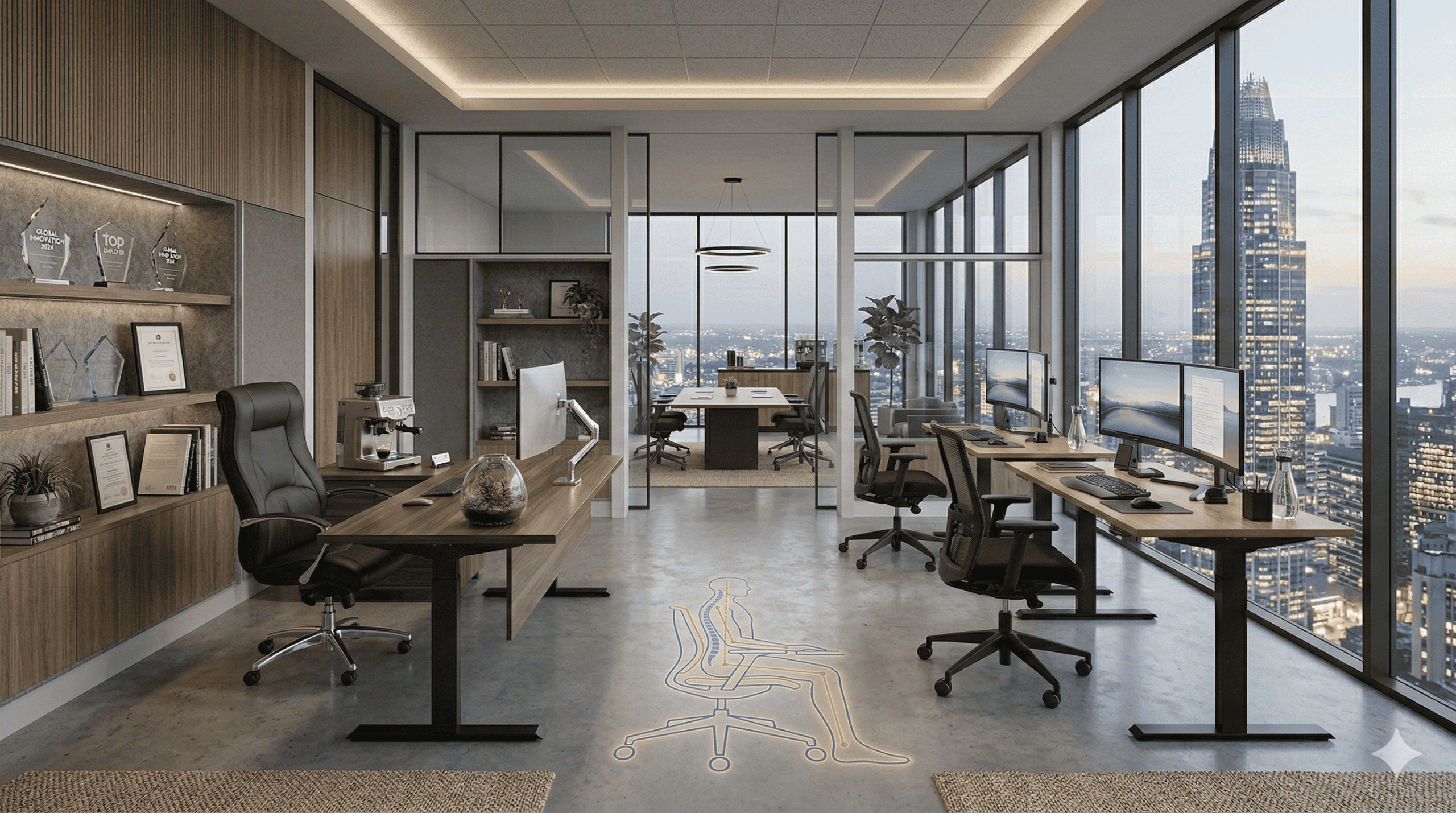
The newest height-adjustable desks connect to apps via Bluetooth or WiFi. They remember individual height preferences. They track how long a user has been sitting. Some will nudge users to stand up after a set period of time.
In hot desking environments — where staff don’t have a fixed desk — this is particularly useful. A staff member books a desk through an app, and when they sit down, their preferred desk height is already saved in the system. No fiddling with buttons.
For WHS (Workplace Health and Safety) purposes, this data is valuable too. Facilities managers can see which desks are being used in sit mode versus stand mode. That informs future purchasing decisions and helps demonstrate duty of care.
In Australia, well-supported options for height-adjustable desks with app connectivity are available from around $1,200 to $2,500 per unit depending on the brand, motor quality and software integration. Progressive Corporate manufactures height-adjustable desks locally and can integrate app connectivity into fitout projects.
2. Wireless Charging Built Into Desks and Tables
Qi wireless charging has been built into smartphones for years. Now its making its way into office desktops and meeting tables.
Desks with embedded wireless charging pads let staff place their phone on the desk surface and charge it — no cable needed. Meeting tables with charging surfaces built in mean there’s no tangled cord mess in the middle of the table.
It sounds like a small thing. But it changes how tables get designed. Cable management becomes a design feature rather than an afterthought. Surfaces need to be thinner in the right places. The charging hardware needs to be integrated at the manufacturing stage — not retrofitted.
There are some practical limitations worth knowing. Not all phone cases work with wireless charging. Phones need to be positioned correctly on the pad. And the charging speeds are slower than a cable. For a quick top-up during a meeting, it works well. For fully charging a flat phone, it’s too slow.
Still, for meeting tables and boardrooms, wireless charging integration is becoming a standard expectation for corporate clients.
3. Sensor-Equipped Furniture for Space Utilisation
This is where smart furniture gets genuinely powerful — and also where it gets a bit more complicated.
Occupancy sensors can be built into chairs and desks. They detect whether a space is being used. That data feeds into a facilities dashboard that shows, in real time, which desks and meeting rooms are occupied and which aren’t.
For businesses paying rent on space they don’t fully use, this is valuable information. If your sensor data shows 40% of your desks are empty every day, that’s a strong case for downsizing to a smaller floorplate at lease renewal.
Facilities managers use this data for cleaning rosters too. Rooms and desks that weren’t used that day don’t need cleaning. That saves money and reduces chemical use.
The privacy angle is important in Australia. Employers need to be transparent about what’s being tracked. Sensors that track occupancy (is the space being used: yes or no) are generally fine. Sensors that track individuals (where is this specific person right now) require much more careful handling under Australian privacy law. If you’re specifying sensor-equipped furniture, get HR and legal involved early.
4. Video-Conferencing Furniture Designed for Camera and Audio
Hybrid work has changed what a meeting room needs to do. When half the team is in the room and half is on a screen, the furniture has to work on camera.
Old boardroom tables weren’t designed for this. They’re too wide. They create glare. They make it hard for the camera to see everyone. The acoustic surfaces bounce sound in unhelpful ways.
Furniture designers have responded. Meeting tables are now being shaped and surfaced specifically to reduce glare and echo. Monitor arms are integrated into the table structure. Cable routing is built in so there’s no visible cable clutter behind presenters. Acoustic panels are designed to attach directly to furniture rather than wall-mounted separately.
Some manufacturers are now designing tables with a slight curved or angled shape so that more people face the camera naturally. Smaller, narrower tables work better for hybrid meetings than traditional large rectangular ones.
This is one area where furniture specification and AV specification need to happen together. If the furniture designer and the AV installer aren’t talking to each other, you’ll end up with a room that looks good but performs badly on screen.
5. App-Controlled Booking and Hot Desk Systems
Hot desking has been around for a while. But the technology supporting it has improved significantly.
Modern systems use NFC tags or QR codes attached to desks and meeting rooms. Staff scan the tag to check in. The system knows who is sitting where. It connects to desk booking apps that integrate with Microsoft 365 and Google Workspace.
For a Melbourne business with 40 staff and 30 desks — common in a hybrid environment — this kind of system makes real sense. Staff can see which desks are available before they leave home. They book their preferred spot. They can see where their colleagues are sitting that day.
From a facilities management perspective, the data is gold. You know actual utilisation rates, not just what the booking calendar says. You can see patterns. You can make better decisions about space.
The furniture side of this is simpler than it sounds. It mostly involves attaching a small NFC tag to the desk or integrating a small sensor module. The smart part is the software, not the furniture. But the furniture needs to be designed so the tag or sensor can be attached neatly and durably.
What Smart Furniture Is NOT Worth Buying Yet
Not everything marketed as smart office furniture is worth the money right now. Here’s an honest take.
AI-powered chairs that claim to monitor your posture in real time and coach you to sit better — they sound impressive but the real-world results are mixed. The sensors are often inaccurate. The coaching notifications become annoying quickly. And at $3,000+ per chair, the ROI is hard to justify.
Mood-sensing desks and environment-responsive furniture — products that claim to adjust lighting or temperature based on detected stress levels — are still very early stage. The tech isn’t reliable enough for a commercial environment in 2026.
Furniture with built-in screens or touch panels on the desk surface tends to be expensive, fragile and quickly outdated. A $5,000 desk with a built-in touchscreen display will feel dated in three years when the software isn’t supported anymore.
The trap is buying technology that becomes obsolete faster than the furniture itself. Good quality commercial furniture should last 10 to 15 years. If the tech component locks you into a software subscription or fails after three years, you’ve undermined the whole investment.
Our view at Progressive Corporate: technology should support the furniture, not replace good design. Start with furniture that’s built to last. Add technology that solves a specific problem you actually have. Don’t add technology just because it sounds impressive.
What to Consider Before Specifying Smart Furniture for Your Office
If you’re planning a fitout that includes smart furniture elements, here are the things to sort out before you start specifying product.
IT infrastructure first. Smart furniture needs reliable WiFi coverage across the whole floorplate. It needs sufficient power points. Some sensor systems need their own network segment separate from the main office network. If your IT infrastructure isn’t ready, smart furniture won’t work properly.
Who manages the software? Desk booking systems and sensor dashboards need someone to manage them. Is that your facilities team? Your IT team? Make sure someone owns it before you go live.
Warranty and support. When the tech component fails — and at some point it will — who fixes it? Overseas brands with no Australian service network are a real risk. If the manufacturer’s local support is thin, you’ll be waiting weeks for parts or relying on a tech that’s never seen the product before.
Budget reality. Smart furniture costs more upfront. But it can reduce real estate costs long term by helping you right-size your space. If sensor data shows you’re running at 60% utilisation, you may be able to reduce your floorplate at next lease renewal — potentially saving far more than the technology cost.
Local supplier support matters. This is especially true in Melbourne’s eastern suburbs where Progressive Corporate is based. Businesses in Knox, Glen Waverley, Ringwood and surrounding areas benefit from having a local manufacturer and supplier who can come on-site when issues arise, not just send an email.
Smart Furniture Cost Guide: What to Expect in Australia (2026)
| Product | Entry Level | Mid to High Range |
| App-connected sit-stand desk | $1,200 – $1,600 | $1,800 – $2,500 |
| Wireless charging desk surface | $800 – $1,200 | $1,400 – $2,000 |
| Occupancy sensor (per desk) | $80 – $150 | $180 – $350 |
| Desk booking software (per user/yr) | $60 – $100 | $120 – $200 |
| Video-conf optimised meeting table | $2,500 – $4,000 | $4,500 – $8,000+ |
Note: prices are indicative for Australian market 2026. Installed costs will be higher. Get a written quote based on your specific requirements.
What Melbourne Businesses Are Actually Doing in 2026
There’s a big gap between what gets written about in design magazines and what actually gets installed in Melbourne offices. Here’s a realistic picture.
The most common starting point for local businesses is height-adjustable desks with app connectivity. Its a single purchase that improves ergonomics, supports hybrid work and delivers useful data. For businesses moving to hot desking, its often the first smart furniture investment they make.
Wireless charging in meeting tables is the second most common addition, particularly for boardrooms and client-facing spaces. Its relatively low cost to include at the manufacturing stage and clients notice it.
Desk booking software is being adopted widely, but it’s often separated from the furniture entirely. Many businesses use a software platform and attach simple QR code labels to existing desks. The smart part is the software, not the furniture — and thats fine.
Full sensor integration — where every desk has an occupancy sensor feeding a live dashboard — is still mostly the domain of larger corporate clients. Businesses with 100+ staff and multiple floors are the ones making this investment. For smaller businesses, the cost-to-benefit ratio doesn’t quite stack up yet.
AI systems, mood-sensing furniture and fully automated environments? Almost nobody in Melbourne is doing this at a commercial scale in 2026. It makes for good press releases but its not what’s being specified on the ground.
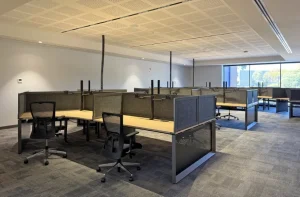
How Progressive Corporate Approaches Tech-Integrated Fitouts
Progressive Corporate has been designing and manufacturing commercial office furniture in Melbourne since 1989. We’re based in Knoxfield, in the eastern suburbs, and we manufacture locally.
When clients come to us about smart furniture, we start by asking what problem they’re trying to solve. Not what technology they want to buy. The technology should follow the problem — not the other way around.
Because we manufacture our own furniture, we can integrate tech components at the production stage rather than retrofitting them later. Wireless charging surfaces, cable management systems, and sensor mounting points are all easier and cleaner when they’re designed in from the start.
We’ve delivered fitouts for corporate clients including Telstra, RMIT and Victoria Police — all of which have complex technology requirements and strict procurement processes. That experience means we understand how to coordinate furniture specification with IT, AV and facilities management teams.
If you’re planning a fitout that includes smart furniture elements, the best time to talk to us is before you’ve locked in the floor plan. Technology decisions affect furniture layout. Furniture layout affects technology decisions. Getting us in early means you avoid expensive changes later.
Call us on 03 7018 0761 or email sales@progressiveoffice.com.au. We’re based in Knoxfield and service clients across greater Melbourne.
Frequently Asked Questions
Is smart office furniture worth the extra cost?
It depends on the product. Height-adjustable desks with app connectivity offer real productivity and WHS benefits and are worth the premium for most businesses. Full sensor integration for space utilisation makes strong financial sense for larger offices where real estate costs are significant. Novelty technology like AI-powered chairs or mood-sensing surfaces — probably not yet.
Can smart furniture work with my existing office setup?
Some products can be added to an existing setup with minimal disruption. Desk booking software with QR code labels is a good example. Others — like wireless charging surfaces or fully integrated sensor systems — work best when designed in from the start. If you’re planning a refurbishment rather than a full fitout, ask specifically what can be retrofitted and what can’t.
What’s the most useful piece of smart furniture to start with?
For most Melbourne businesses in 2026, an app-connected height-adjustable desk is the most practical starting point. It solves a real problem (ergonomics and hot desking), it delivers useful data, and its widely available with good local support.
Does smart furniture require ongoing software subscriptions?
Usually yes. Desk booking platforms, sensor dashboards and desk management apps are typically sold as annual subscriptions. Factor this into your total cost of ownership calculation. For a 50-desk office, software costs might add $3,000 to $8,000 per year depending on the platform.
Can Progressive Corporate supply and install tech-integrated furniture in Melbourne?
Yes. We manufacture office furniture locally in Knoxfield and can incorporate technology components into our standard product range. We also coordinate with AV installers and IT teams to make sure smart furniture elements work as part of a broader fitout. Contact us at the start of your project for the best results.
The Bottom Line
Smart office technology is genuinely changing how furniture is designed. The shift is real, not just marketing.
But the best smart furniture decisions are driven by actual problems — too many empty desks, difficulty managing hybrid work, WHS obligations, poor meeting room performance on video calls. Technology that solves a real problem is worth buying. Technology that sounds impressive but doesn’t solve anything is not.
In 2026, the most practical investments for Melbourne businesses are app-connected sit-stand desks, wireless charging meeting tables, and desk booking software. These are proven, widely available, and deliver measurable returns.
Full sensor integration, AI furniture, and mood-responsive environments are coming — but they’re not quite ready for the average Melbourne office yet.
If you’re planning a fitout and want honest advice about what technology is worth including, talk to Progressive Corporate. We’ve been fitting out Melbourne offices for over 35 years. We’ll tell you what works and what doesn’t — based on what we actually see being installed, not what’s being written about in design blogs.
Call 03 7018 0761 or email sales@progressiveoffice.com.au.